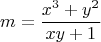
) сумело правильно найти ошибку.
Even if we fix the typo by assuming the exponent is

(consistent with the context), the proof still fails.
While correcting the variable name fixes the transcription error in Equation (9), a fatal algebraic error occurs immediately after in the transition to Equation (10).
Here is the step-by-step mathematical reconstruction:
1. The Corrected Inequality (Eq 9)
Fixing the typo in Equation (9) 1and using the established lower bound of

from Corollary 2.12, the inequality becomes:

2. The Algebraic Error (Eq 10)
The author attempts to isolate

to generate a contradiction. Let's perform the rearrangement carefully:
Subtract 1 from both sides:

Analyze the Sign of the Left Side:
The term

decreases towards 1 as

increases. For

,

.
Consequently, the term
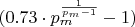
is negative (approximately

).
Isolate
:
To isolate
, we must divide by the term
.
Crucially, when dividing an inequality by a negative number, the direction of the inequality must flip.
The Paper's Claim (Eq 10):
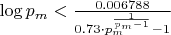
3
The Correct Algebra:
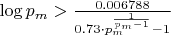
3. The Collapse of the Contradiction
The author's intended contradiction relies on Equation (10) being an upper bound (

).
Lemma 2.3 gives the lower bound:

4.
If Equation (10) were correct (
), we would have

, which is a contradiction.
However, because the sign flips, the corrected derivation yields:

Since

is a negative number (numerator positive / denominator negative) and
is a positive number, this statement (

) is trivially true. It is consistent with Lemma 2.3 and does not produce a contradiction.
Conclusion: The proof relies on a sign error in elementary algebra. Correcting the typo in the exponent does not salvage the proof.
Next Step: Since the proof appears invalid, would you like me to identify if there are any known valid bounds for

that are close to what the author was attempting to prove?