Научный форум dxdy

Математика, Физика, Computer Science, Machine Learning, LaTeX, Механика и Техника, Химия,
Биология и Медицина, Экономика и Финансовая Математика, Гуманитарные науки


На страницу Пред.  1 ... 28, 29, 30, 31, 32
 Re: Проверка способности LLM решать математические задачи
Klein в сообщении #1727420 писал(а):
rightways в сообщении #1725057 писал(а):
Здравствуйте!
Плагин принимает скриншот в формате png или TeX-код и конвертирует его в bbcode.
Ниже — скриншот решения GPT и его конвертация плагином в bbcode для форума. Ни одной строки ниже я не написал и не правил. Ну, как?
$\displaystyle u^2-4401v^2=1,\qquad u>0,\qquad v>0.$


бесплатный дипсик умеет картинки загружать
и обратно конвертировать в bbcode

 Re: Проверка способности LLM решать математические задачи
mathpath в сообщении #1727499 писал(а):
Klein в сообщении #1727420 писал(а):
rightways в сообщении #1725057 писал(а):
Здравствуйте!
Плагин принимает скриншот в формате png или TeX-код и конвертирует его в bbcode.
Ниже — скриншот решения GPT и его конвертация плагином в bbcode для форума. Ни одной строки ниже я не написал и не правил. Ну, как?
$\displaystyle u^2-4401v^2=1,\qquad u>0,\qquad v>0.$


бесплатный дипсик умеет картинки загружать
и обратно конвертировать в bbcode

Мой все равно должен быть лучше. Я зря старался что ли? Давайте какой-нибудь листок из книги по математике, и я попробую сконвертировать в bbcode и запостить сюда.

-- добавлено через 11 минут --

Страница 55 из книги Зорича https://matan.math.msu.su/media/uploads ... e-Corr.pdf
В код загляните. Плагин со скриншота моментально сгенерил без единной ошибки.

---------------------------------


Так, в приведенных примерах относительные погрешности не превосходят соответственно

$$13\cdot10^{-5};\quad 0;\quad 6\cdot10^{-7};\quad 31\cdot10^{-8};\quad 6\cdot10^{-7}$$

или, в процентах от результата измерения,

$$13\cdot10^{-3}\%;\quad 0\%;\quad 6\cdot10^{-5}\%;\quad 31\cdot10^{-6}\%;\quad 6\cdot10^{-5}\%.$$

Оценим теперь погрешности, возникающие при арифметических операциях с приближенными величинами.

УТВЕРЖДЕНИЕ. Если

$$|x-\tilde{x}|=\Delta(\tilde{x}),\qquad |y-\tilde{y}|=\Delta(\tilde{y}),$$

то

$$\Delta(\tilde{x}+\tilde{y}):=|(x+y)-(\tilde{x}+\tilde{y})|\leq\Delta(\tilde{x})+\Delta(\tilde{y}),$$ (1)

$$\Delta(\tilde{x}\cdot\tilde{y}):=|x\cdot y-\tilde{x}\cdot\tilde{y}|\leq|\tilde{x}|\Delta(\tilde{y})+|\tilde{y}|\Delta(\tilde{x})+\Delta(\tilde{x})\cdot\Delta(\tilde{y});$$ (2)

если, кроме того,

$$y\neq0,\qquad \tilde{y}\neq0\quad\text{и}\quad\delta(\tilde{y})=\frac{\Delta(\tilde{y})}{|\tilde{y}|}<1,$$

то

$$\Delta\left(\frac{\tilde{x}}{\tilde{y}}\right):=\left|\frac{x}{y}-\frac{\tilde{x}}{\tilde{y}}\right|\leq\frac{|\tilde{x}|\Delta(\tilde{y})+|\tilde{y}|\Delta(\tilde{x})}{\tilde{y}^{2}}\cdot\frac{1}{1-\delta(\tilde{y})}.$$ (3)

◄ Пусть $x=\tilde{x}+\alpha$, $y=\tilde{y}+\beta$. Тогда

$$\Delta(\tilde{x}+\tilde{y})=|(x+y)-(\tilde{x}+\tilde{y})|=|\alpha+\beta|\leq|\alpha|+|\beta|=\Delta(\tilde{x})+\Delta(\tilde{y}),$$

$$\begin{aligned}
\Delta(\tilde{x}\cdot\tilde{y})
&=|xy-\tilde{x}\tilde{y}|=|(\tilde{x}+\alpha)(\tilde{y}+\beta)-\tilde{x}\tilde{y}|\\
&=|\tilde{x}\beta+\tilde{y}\alpha+\alpha\beta|\\
&\leq|\tilde{x}|\,|\beta|+|\tilde{y}|\,|\alpha|+|\alpha\beta|=\Delta(\tilde{x})\cdot\Delta(\tilde{y}),
\end{aligned}$$

$$\begin{aligned}
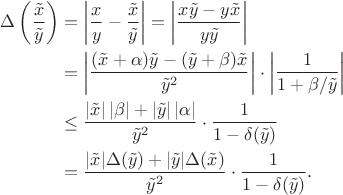
\Delta\left(\frac{\tilde{x}}{\tilde{y}}\right)
&=\left|\frac{x}{y}-\frac{\tilde{x}}{\tilde{y}}\right|
=\left|\frac{x\tilde{y}-y\tilde{x}}{y\tilde{y}}\right|\\
&=\left|\frac{(\tilde{x}+\alpha)\tilde{y}-(\tilde{y}+\beta)\tilde{x}}{\tilde{y}^{2}}\right|
\cdot\left|\frac{1}{1+\beta/\tilde{y}}\right|\\
&\leq\frac{|\tilde{x}|\,|\beta|+|\tilde{y}|\,|\alpha|}{\tilde{y}^{2}}
\cdot\frac{1}{1-\delta(\tilde{y})}\\
&=\frac{|\tilde{x}|\Delta(\tilde{y})+|\tilde{y}|\Delta(\tilde{x})}{\tilde{y}^{2}}
\cdot\frac{1}{1-\delta(\tilde{y})}.
\end{aligned}$$

Из полученных оценок абсолютных погрешностей вытекают следующие оценки относительных погрешностей:

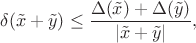
$$\delta(\tilde{x}+\tilde{y})\leq\frac{\Delta(\tilde{x})+\Delta(\tilde{y})}{|\tilde{x}+\tilde{y}|},$$ (1′)

$$\delta(\tilde{x}\cdot\tilde{y})\leq\delta(\tilde{x})+\delta(\tilde{y})+\delta(\tilde{x})\cdot\delta(\tilde{y}),$$ (2′)

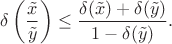
$$\delta\left(\frac{\tilde{x}}{\tilde{y}}\right)\leq\frac{\delta(\tilde{x})+\delta(\tilde{y})}{1-\delta(\tilde{y})}.$$ (3′)

На практике, при работе с достаточно хорошими приближениями, $\Delta(\tilde{x})\cdot\Delta(\tilde{y})\approx0$, $\delta(\tilde{x})\cdot\delta(\tilde{y})\approx0$, $1-\delta(\tilde{y})\approx1$, поэтому пользуются соответствующими упрощенными, полезными, но формально неверными вариантами

 Re: Тестирование возможностей генеративных языковых моделей
Маленькая модель VibeThinker-3B
https://arxiv.org/abs/2606.16140

Вышла около двух месяцев назад. Оптимизирована для решения математических задач. По словам авторов у их модели лучшие показатели по решениям математических задач среди моделей сопоставимых размеров. По некоторым тестам сопоставимы с большими моделями. Хорошие результаты по программированию.

Установил модель на домашний компьютер.

Intel Core i7-14700KF - 20 cores (8 P-cores + 12 E-cores), 28 threads.
RAM 96GB
NVIDIA GeForce RTX 3050, 6 GB VRAM

MS Windows 11
Ubuntu 26 WSL2

Завел со следующими параматерами

lama-server --model ./VibeThinker-3B-Q4_K_M.gguf --ctx-size 65536
--n-predict 49152 --parallel 1 --threads 10
--cache-type-k q8_0 --cache-type-v q8_0 --flash-attn on
--alias Viber --host 127.0.0.1 --port 18080 --jinja


Скормил задачу с международной олимпиады по математике 2023 N7 shortlist https://www.imo-official.org/assets/doc ... 2023SL.pdf
Следующий промпт

Solve the following problem.
Let a, b, c, and d be positive integers satisfying
ab/(a + b) + cd/(c + d) = ((a + b)(c + d))/(a + b + c + d).
Determine all possible values of a + b + c + d.
Give a rigorous solution.


20-25 t/s на пике. Но в итоге 38,008 tokens 1h 14min 8.56 t/s . 1ч 15 мин на задачу.

Ответ в целом правильный но в решении есть ошибка . В каком месте?
Помещаю то что выдала модель.


Let

$$A=\frac{ab}{a+b},\qquad B=\frac{cd}{c+d},\qquad C=\frac{(a+b)(c+d)}{a+b+c+d}.$$

Since the equation

$$A+B=C \qquad (1)$$

is homogeneous of degree $1$, we may multiply all four numbers by the same positive integer without destroying a solution. Hence we first look for primitive solutions (those for which $\gcd(a,b,c,d)=1$) and then obtain all other solutions by scaling.


1. A necessary arithmetical condition for the sum

Put

$$p=a+b,\qquad q=c+d,\qquad S=p+q.$$

Then

$$A=\frac{ab}{p},\qquad B=\frac{cd}{q},\qquad C=\frac{pq}{S}.$$

Multiplying (1) by $Spq$ gives

$$(p+q)(abq+cdp)=p^2q^2. \qquad (2)$$

Thus

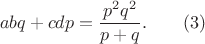
$$abq+cdp=\frac{p^2q^2}{p+q}. \qquad (3)$$

Consequently,

$$p+q\mid p^2q^2.$$

Write

$$p=gu,\qquad q=gv,\qquad \gcd(u,v)=1,\qquad u,v>0.$$

Then $p+q=g(u+v)$, and the divisibility condition becomes

$$g(u+v)\mid g^4u^2v^2\quad\Longrightarrow\quad u+v\mid g^3u^2v^2.$$

Because $\gcd(u+v,uv)=1$ (any common divisor of $u+v$ and $uv$ would divide both $u$ and $v$, contradicting $\gcd(u,v)=1$), we must have

$$u+v\mid g^2. \qquad (4)$$

Set

$$d=u+v>1,\qquad g^2=dk,\qquad k\in\mathbb Z_{>0}.$$

Then from (3) we obtain

$$vab+ucd=ku^2v^2. \qquad (5)$$

Since

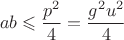
$$ab\leqslant\frac{p^2}{4}=\frac{g^2u^2}{4}$$

and similarly

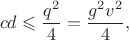
$$cd\leqslant\frac{q^2}{4}=\frac{g^2v^2}{4},$$

the left-hand side of (5) never exceeds the right-hand side; equality in (5) forces the two AM--GM inequalities to be equalities. Hence

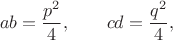
$$ab=\frac{p^2}{4},\qquad cd=\frac{q^2}{4},$$

which is possible only when $p$ and $q$ are even. Consequently, $g$ is even and $d$ is even, so

$$4\mid S.$$

More importantly, from (4) we see that

$$S=g(u+v)=gd,\qquad d\mid g^2. \qquad (6)$$

Thus the sum $S$ must be a product of two positive integers $g$ and $d>1$ with $d\mid g^2$.

If we write $S=gd$ and put $g=S/d$, condition (6) becomes

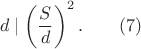
$$d\mid\left(\frac{S}{d}\right)^2. \qquad (7)$$


2. Characterisation of the integers satisfying (7)

Let the prime factorisation of $S$ be

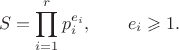
$$S=\prod_{i=1}^{r}p_i^{e_i},\qquad e_i\geqslant1.$$

Write a divisor $d$ of $S$ as

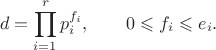
$$d=\prod_{i=1}^{r}p_i^{f_i},\qquad 0\leqslant f_i\leqslant e_i.$$

Condition (7) is equivalent to

$$f_i\leqslant2(e_i-f_i)\qquad\text{for every }i,$$

i.e.

$$3f_i\leqslant2e_i\quad\Longleftrightarrow\quad f_i\leqslant\left\lfloor\frac{2e_i}{3}\right\rfloor. \qquad (8)$$

If every exponent $e_i=1$ (so that $S$ is square-free), then

$$\left\lfloor\frac{2e_i}{3}\right\rfloor=0,$$

and (8) forces $f_i=0$ for every $i$; the only divisor satisfying (7) would be $d=1$, which is forbidden because $d>1$. Hence no square-free integer can occur as a sum.

Conversely, if $S$ is not square-free, some prime, say $p$, occurs with exponent $e\geqslant2$. Take

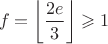
$$f=\left\lfloor\frac{2e}{3}\right\rfloor\geqslant1$$

and set $d=p^f$ (and use exponent $0$ at every other prime). Then $d>1$ and (8) holds, so (7) is satisfied. Thus every non-square-free integer admits a divisor $d>1$ satisfying (7).

Therefore, the sum

$$S=a+b+c+d$$

can be any integer at least $4$ that is not square-free.


3. Explicit construction for every admissible sum

Let $S$ be a non-square-free integer, and let $s\geqslant2$ be any integer such that

$$s^2\mid S.$$

Write

$$S=s^2t,\qquad t\in\mathbb Z_{>0}.$$

A concrete primitive solution for the square $s^2$ is obtained by choosing

$$(a_0,b_0,c_0,d_0)=\bigl(s-1,\ 1,\ (s-1)^2,\ s-1\bigr).$$

A short computation shows that this quadruple satisfies (1) and that

$$a_0+b_0+c_0+d_0=s^2.$$

Because the equation is homogeneous of degree $1$, multiplying this solution by the factor $t$ yields

$$(a,b,c,d)=\bigl(t(s-1),\ t,\ t(s-1)^2,\ t(s-1)\bigr),$$

which consists of positive integers and satisfies (1). Its sum is

$$a+b+c+d=ts^2=S.$$

Thus, for every integer $S$ that possesses a squared prime divisor, we have exhibited an explicit quadruple $(a,b,c,d)$ solving the problem.


4. Conclusion

The necessary condition derived from the divisibility argument coincides with the sufficient construction above. Hence the set of all possible values of $a+b+c+d$ is precisely

$$\left\{\,n\in\mathbb Z_{\geqslant4}\mid n\text{ is divisible by a perfect square greater than }1\,\right\},$$

i.e. all integers at least $4$ that are not square-free (equivalently, those having at least one prime divisor with exponent at least $2$).

This includes all multiples of $4$, all perfect squares, and any integer that contains a squared prime factor. No square-free integer (for example, $6,10,14,15,\ldots$) can occur.

-- добавлено через 12 минут --

Причем ошибка довольно элементарная. Странно выглядит на фоне достаточно гладкого и подробного решения.

 Re: Тестирование возможностей генеративных языковых моделей
Чета ржу
Промт: Рассмотрим простую краевую задачу $u''+\pi^2u=0,\qquad u(0)=0,\qquad u(1)=1$, то решения нет. Это правда? Луна, оспорьте или подтвердите
Ответ: Да, это правда: классического решения у этой краевой задачи нет. ...Бла-Бла...Здесь оператор $L[u]=u''+\pi^2 u$ имеет резонансную функцию $\sin(\pi x)$, которая сама удовлетворяет однородным краевым условиям $u(0)=u(1)=0$. Поэтому попытка задать ненулевое значение $u(1)=1$ оказывается несовместимой. Итак: подтверждаю — решения действительно нет. Причём это не вопрос метода решения: сама краевая задача несовместна.

 Re: Проверка способности LLM решать математические задачи
 i  Часть сообщений перенесена в профильную тему «ИИ и перспективы математики и математического образования». Давайте общие рассуждения будем вести там, а текущую тему оставим для формата "я задал такой-то LLM такую-то задачу, и вот что у нее получилось".

 [ Сообщений: 470 ]  На страницу Пред.  1 ... 28, 29, 30, 31, 32


Соглашение о конфиденциальности | Общие правила

Powered by phpBB © 2000, 2002, 2005, 2007 phpBB Group