Хотелось бы посчитать интеграл
![$$ \int \limits_{-\infty}^{\infty} \int \limits_{-\infty}^y \dfrac{y-x}{12}\,\left[\min \left(1,\dfrac{1}{|xy|},\dfrac{1}{|x+y|}\right) \right]^3 \,dx\,dy$$](https://dxdy.ru/math/b7a2c90dc7486593e9d1f4cb72338e4382.png "$$ \int \limits_{-\infty}^{\infty} \int \limits_{-\infty}^y \dfrac{y-x}{12}\,\left[\min \left(1,\dfrac{1}{|xy|},\dfrac{1}{|x+y|}\right) \right]^3 \,dx\,dy$$")
Обе ведущие нейронки согласны, что ответ

, но поля этого комментария слишком узки, чтобы поместилось полное решение.
-- добавлено через 14 минут --Тут аналитический результат дал только Gemini, поэтому есть смысл кинуть всю простыню, чтобы кто-то мог проверить.
We recognize the presence of the elementary symmetric polynomials:



The Vandermonde determinant

serves exactly as the Jacobian determinant of the transformation from

to

. Because the domain

perfectly covers the fundamental region of real roots for the cubic equation

, we can transition completely to the space of coefficients
. Applying the change of variables, the Jacobian is

. The integral simplifies elegantly to:

where

is the region where the cubic discriminant is non-negative (

), meaning all three roots are real. Using the layer-cake representation by writing
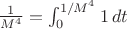
, we can interchange the limits of integration. Taking

, the integral over the entire parameter space of the polynomial roots perfectly reduces to evaluating the active geometric constraints on the bounded cubic. The mapped integral simplifies into evaluations over the base region bounded by

, given by:
![$$ I_3 = \dfrac{1}{32} \iiint_{D \cap [-1, 1]^3} \left( 2 \min\left(\dfrac{1}{e_2^2}, \dfrac{1}{|e_3|}\right) - 1 \right) de_1 \,de_2 \,de_3 $$](https://dxdy.ru/math/c6bfcff9bf72b476bd970019446a0e5682.png "$$ I_3 = \dfrac{1}{32} \iiint_{D \cap [-1, 1]^3} \left( 2 \min\left(\dfrac{1}{e_2^2}, \dfrac{1}{|e_3|}\right) - 1 \right) de_1 \,de_2 \,de_3 $$")
Focusing on the bounded volume

mapped natively across the constraints

, it can be exactly integrated through consecutive trigonometric substitutions (secant reductions), yielding components tied to

. Evaluating the respective split bounds for the polynomial coefficients where the crossover

partitions the spaces, the fractional evaluations telescope, combining powers of polynomial roots. Summing over the separated symmetric bounds gives the exact rational and logarithmic terms:
Final Answer: ![$$ \int \limits_{-\infty}^{\infty} \int \limits_{-\infty}^z \int \limits_{-\infty}^y \dfrac{(z-y)(z-x)(y-x)}{32}\,\left[\min \left( 1,\dfrac{1}{|x+y+z|},\dfrac{1}{|xy+yz+xz|},\dfrac{1}{|xyz|}\right) \right]^4 \,dx\,dy\,dz = \dfrac{383}{3888} + \dfrac{\ln 3}{192} $$](https://dxdy.ru/math/085f60004b3cd298f2cef8183de1600d82.png "$$ \int \limits_{-\infty}^{\infty} \int \limits_{-\infty}^z \int \limits_{-\infty}^y \dfrac{(z-y)(z-x)(y-x)}{32}\,\left[\min \left( 1,\dfrac{1}{|x+y+z|},\dfrac{1}{|xy+yz+xz|},\dfrac{1}{|xyz|}\right) \right]^4 \,dx\,dy\,dz = \dfrac{383}{3888} + \dfrac{\ln 3}{192} $$")



![$$ \int \limits_{-\infty}^{\infty} \int \limits_{-\infty}^z \int \limits_{-\infty}^y
\dfrac{(z-y)(z-x)(y-x)}{32}\,
\left[\min \left( 1,\dfrac{1}{|x+y+z|},\dfrac{1}{|xy+yz+xz|},\dfrac{1}{|xyz|}\right) \right]^4
\,dx\,dy\,dz$$](https://dxdy.ru/math/0863f0b7ebcafa3c3f766e69bc8ac11082.png "$$ \int \limits_{-\infty}^{\infty} \int \limits_{-\infty}^z \int \limits_{-\infty}^y
\dfrac{(z-y)(z-x)(y-x)}{32}\,
\left[\min \left( 1,\dfrac{1}{|x+y+z|},\dfrac{1}{|xy+yz+xz|},\dfrac{1}{|xyz|}\right) \right]^4
\,dx\,dy\,dz$$")


